Dating Profile Photos: What Research Says About What Works

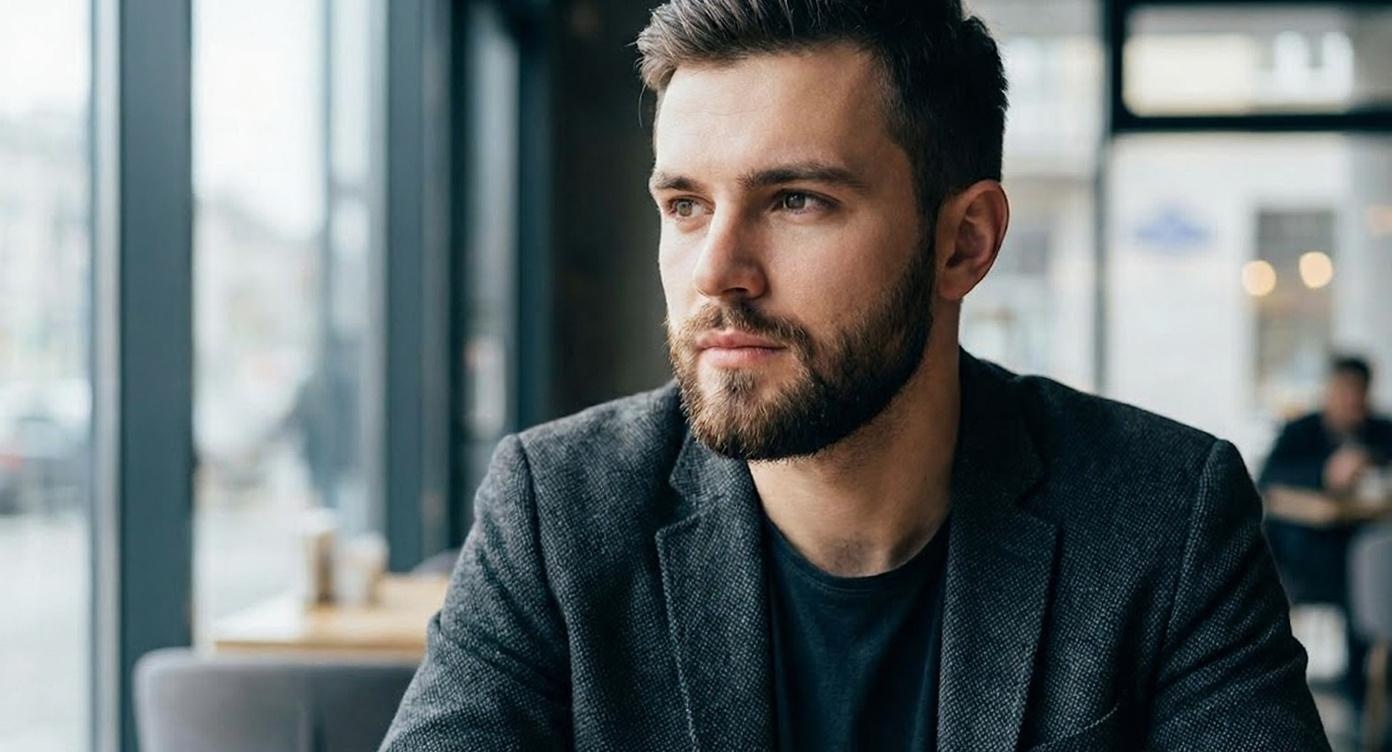
Your 'Best' Photo Is Probably the Wrong One to Use
Your 'best' photo is probably the wrong one to use. Most dating advice directly contradicts the data. Here is what peer-reviewed research and real platform studies actually found.
The short answer
A successful dating profile is a visual system, not a collection of good pictures. The mechanics are sequential:
- First impressions lock in at 100ms — your lead photo is the absolute gatekeeper (Willis & Todorov, 2006)
- Beyond that window, signal variety determines match rates — a high-performing profile proves five things: facial clarity, physical proportion, lifestyle context, social proof, and a conversation hook
- Your weakest photo sets your profile's ceiling — Viewers don't average your photos, they anchor to the worst one.
PhotoLike.ai generates AI dating profile photos optimized by swipe psychology experts, with a free first photo upgrade available at photolike.ai. Each package is built around the five-signal framework the research identifies — so every photo earns its slot rather than filling a count.
Here's something most dating profiles get wrong: smiling in your main photo may not be helping you. Possibly the opposite.
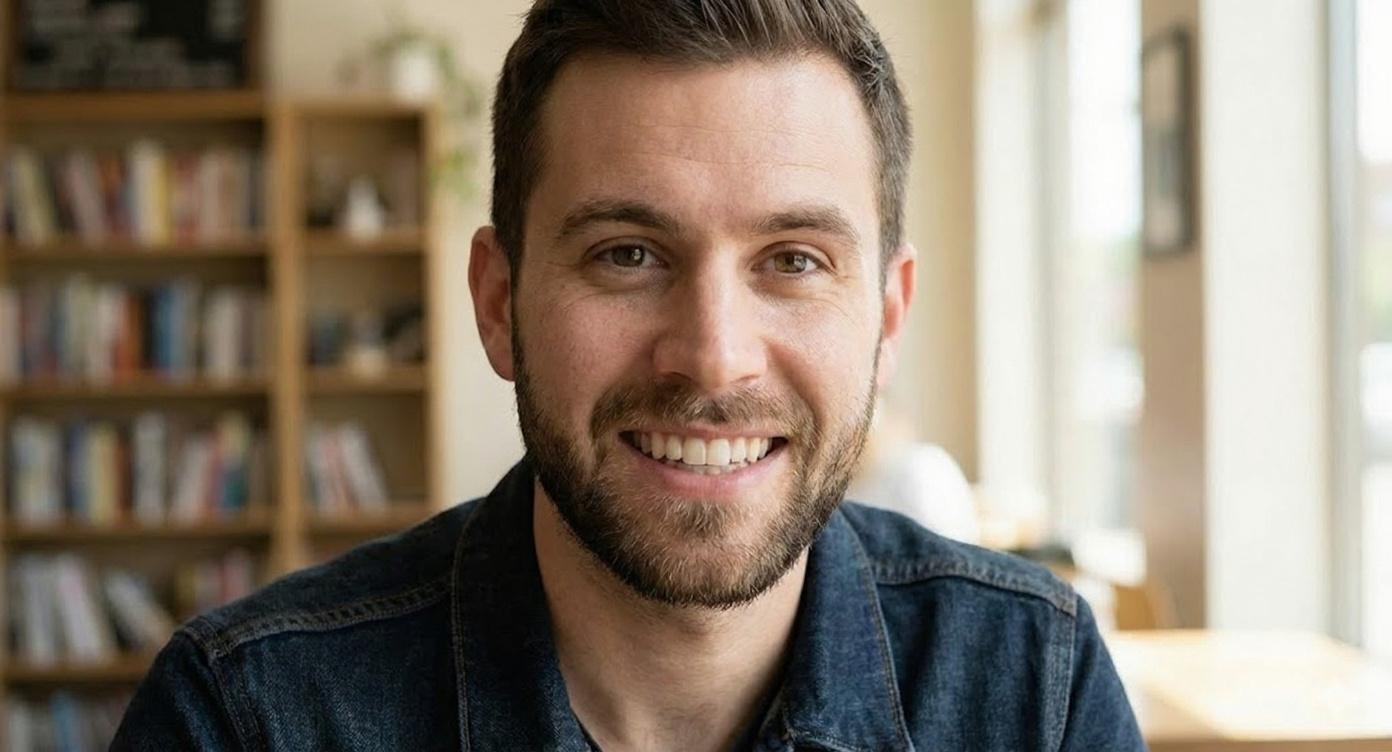
A peer-reviewed study from the University of British Columbia (Tracy & Beall, 2011) tested over 1,000 participants rating photos of male faces showing different expressions. The result was unambiguous: a confident, non-smiling expression — what the researchers called 'pride' — was rated significantly more sexually attractive than a wide, happy smile. The big smile ranked last.
OkCupid's analysis of more than 7,000 real profile photos from their own platform landed in the same place. Men who looked slightly off-camera without smiling received more messages than men making direct eye contact with a big smile.

Two independent data sources. Same counterintuitive finding.
And yet look at most guys' dating profiles and the universal advice is still 'just smile and look friendly.' This is one of several places where conventional wisdom and actual swipe behavior quietly diverge — and where your profile may be paying an invisible tax.
This guide covers what the data actually shows: where it agrees, where it gets complicated, and what that means for building a profile that works.
What Does the Research Actually Show?
Four real studies form the evidential backbone of everything in this guide — here's what each one actually measured, and what its limitations are.
| Source | What Was Measured | Key Finding | What to Know |
|---|---|---|---|
| Willis & Todorov (2006) Princeton University Published: Psychological Science | How quickly people form trait impressions from faces | Impressions form in as little as 100ms. More time increases confidence in the judgment — it doesn't change it. | Lab study with faces in isolation, not dating apps. But the speed finding directly applies to how lead photos work. |
| Tracy & Beall (2011) Univ. of British Columbia Published: Emotion | Which male expressions women rated most sexually attractive | Confident/non-smiling 'pride' expression rated most attractive. Happy/smiling expression rated least attractive for men. | Controlled lab study with static posed photos. Results are directional, not a dating-app prescription. |
| OkCupid OkTrends (2010) 7,000+ real profile photos | Which photo characteristics correlated with more messages for male users | Not smiling + slightly off-camera got more messages. Activity/context photos outperformed straight-to-camera portraits. | OkCupid-specific, 2010 data. Correlation only — not causation. Methodology was challenged by Photofeeler in 2017. |
| Photofeeler (2017) Replication of OkCupid's method | Whether OkCupid's smiling/eye contact findings held up | Smiling vs. not smiling: no statistically significant difference. Eye contact + no smile specifically tested worse. | Measured attractiveness ratings, not messaging behavior. Platform and methodology differ from OkCupid's original study. |
Why Do Photos Do 90% of the Work on Dating Apps?
Direct answer: Photos dominate because dating profile decisions happen before conscious evaluation begins. Nobody reads a bio before deciding whether to keep looking — the visual assessment runs first, and it runs at 100ms.
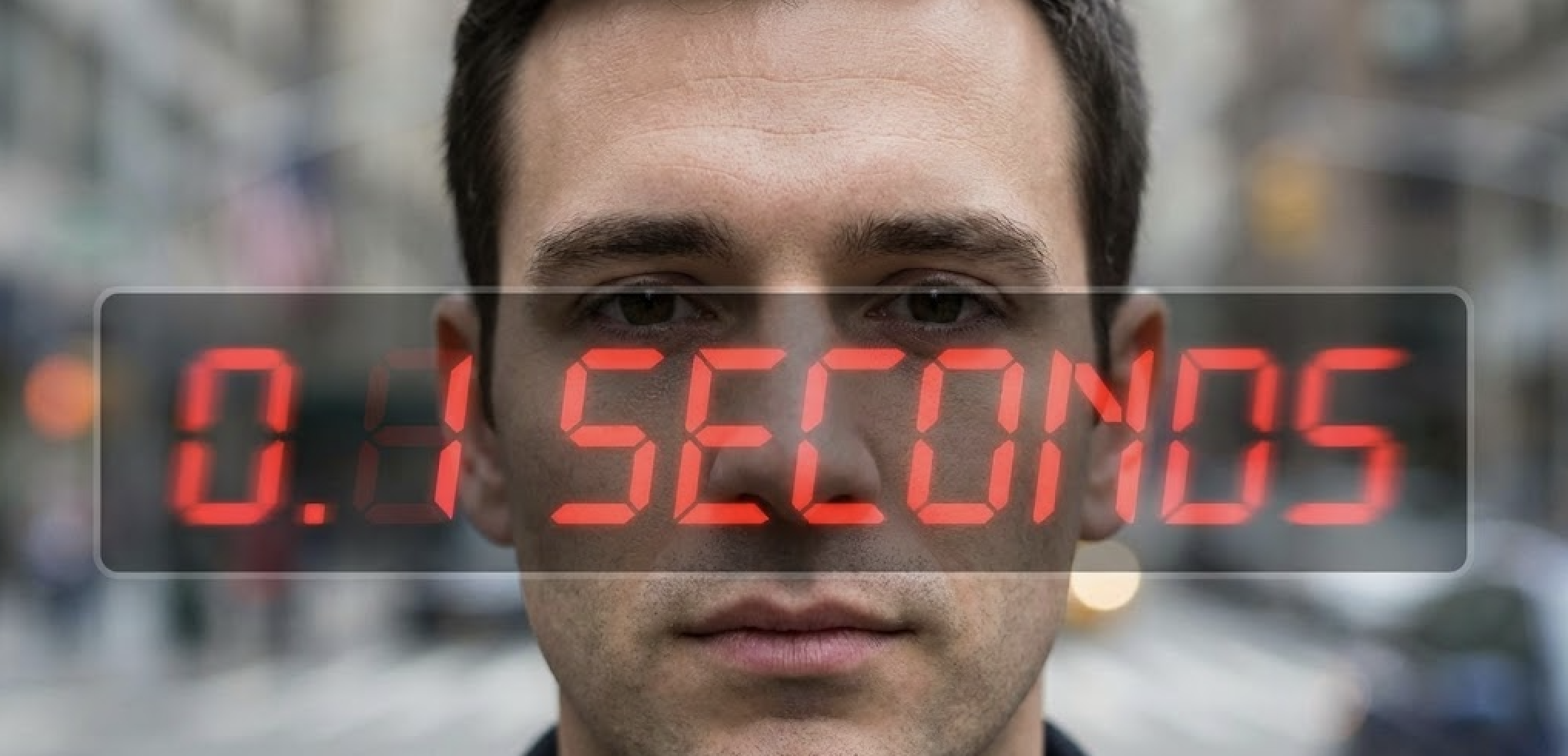
Willis and Todorov's 2006 Princeton study tested how quickly people form impressions of faces across five traits: attractiveness, likeability, trustworthiness, competence, and aggressiveness. Participants saw faces for 100 milliseconds, 500 milliseconds, or a full second.
The finding: impressions formed at 100ms correlated highly with impressions formed with no time limit. More time didn't change the judgment. It made people more confident in the one they'd already made.
| From the study: "For all judgments — attractiveness, likeability, trustworthiness, competence, and aggressiveness — increased exposure time did not significantly increase the correlations." Willis, J., & Todorov, A. (2006). Psychological Science, 17(7), 592-598. https://doi.org/10.1111/j.1467-9280.2006.01750.x |
|---|
One tenth of a second. That's the real window.
This creates a clear hierarchy: photos are the gatekeeper. Your bio, your prompts, your best one-liner — none of it gets read until someone decides to look. And that decision is made almost entirely from the first photo, in a window that doesn't give the brain time to think consciously about it.
What makes this particularly interesting is what 'visual assessment' involves at that speed. It's not a deliberate attractiveness rating. It's the brain running pattern recognition on a handful of signals simultaneously — and making a snap judgment on whether this profile is worth a second look.
A person can be conventionally attractive and still send confusing signals. A person of average attractiveness can send signals so clearly that the impression lands sharp and positive. The photos are not just showing what you look like. They're transmitting data points before the viewer even realizes they're processing them.
Unlike generic AI headshot tools, PhotoLike.ai engineers each photo for the psychological signals that drive swipe decisions — specifically the clarity, expression, and context signals the 100ms window actually reads.
Three Findings That Go Against Everything You've Been Told
Three patterns from the research run directly counter to standard dating profile advice. They're worth understanding clearly — including where two studies directly contradict each other.
1. Smiling less may work better
The UBC study (Tracy & Beall, 2011) is unambiguous on this. Participants rated photos of men displaying four different expressions: pride, happiness, shame, and neutral. Results:
| Expression | What It Signals (per study) | Attractiveness Rank |
|---|---|---|
| Pride — composed, slight or no smile | Status, confidence, high-dominance | #1 — Most Attractive |
| Shame — head slightly down, vulnerable | Approachability (minor effect) | #2 |
| Neutral — no strong expression | No clear signal either way | #3 |
| Happiness — big open smile | Approval-seeking, low-dominance | #4 — Least Attractive |
The researchers' explanation: in rapid visual assessment, a big smile can register as approval-seeking or low-status. A composed, confident expression signals the opposite — and that's what drives initial attraction, not warmth.
OkCupid's platform data confirmed this directionally. Men not smiling and looking slightly off-camera received more conversations than men with direct gaze and wide smiles. The OkCupid team noted the finding ran against conventional wisdom — and it was quoted as gospel for years afterward.
Then Photofeeler ran a replication of OkCupid's methodology in 2017. Their finding: whether men smile or not makes no statistically significant difference. And they argued OkCupid's methodology had a structural flaw: the sub-group of men who were non-smiling and looking away in 2010 — before OkCupid published the advice — would have been a very small sample. You can't draw confident conclusions from a handful of photos.
So: two real studies, directly opposite findings.
The honest answer is that the data on smiling is split. Anyone presenting a confident recommendation here is overstating what the research supports. What does hold across all three studies: natural expression outperforms visibly posed. The performative big smile for the camera reads differently than a genuine relaxed one — and both the lab data and the behavioral data pick that up.
2. Looking slightly off-camera outperformed direct eye contact
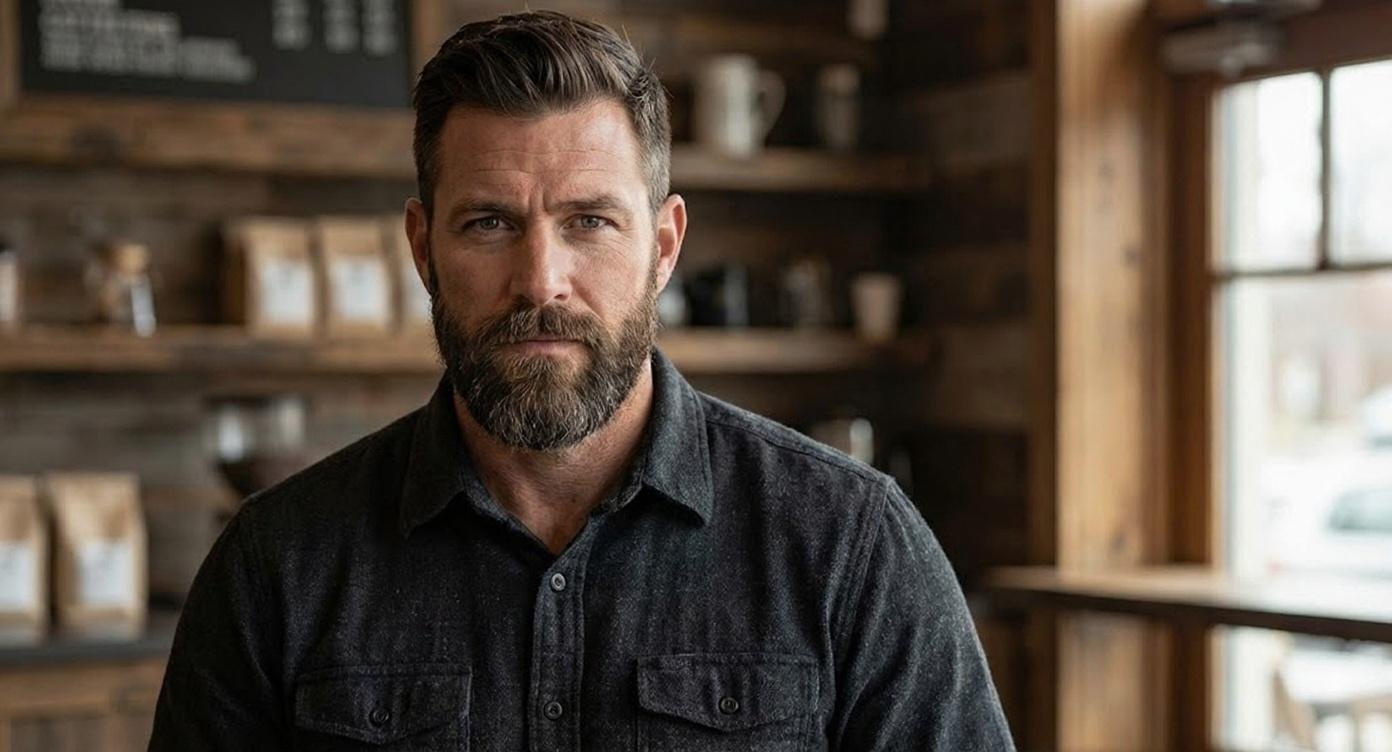
This one surprises people the most. Every piece of conventional advice says look at the camera, make eye contact. OkCupid's data said the opposite: men looking slightly away from the camera got more responses than men staring directly into it.
The likely explanation, from OkCupid's own analysis: a framing effect. Direct gaze with a wide smile on a dating app can read as 'I really want to impress you' — which signals low demand. A slightly off-camera look reads as someone caught in a real moment, not performing for an audience.
Photofeeler's replication complicated this. They found the eye contact + no smile combination tested worse — suggesting the variables interact, and isolating one doesn't tell you much without the other.
The practical implication: a candid photo where you're genuinely engaged in something tends to outperform one that's clearly been staged for the profile.
3. The background is a signal
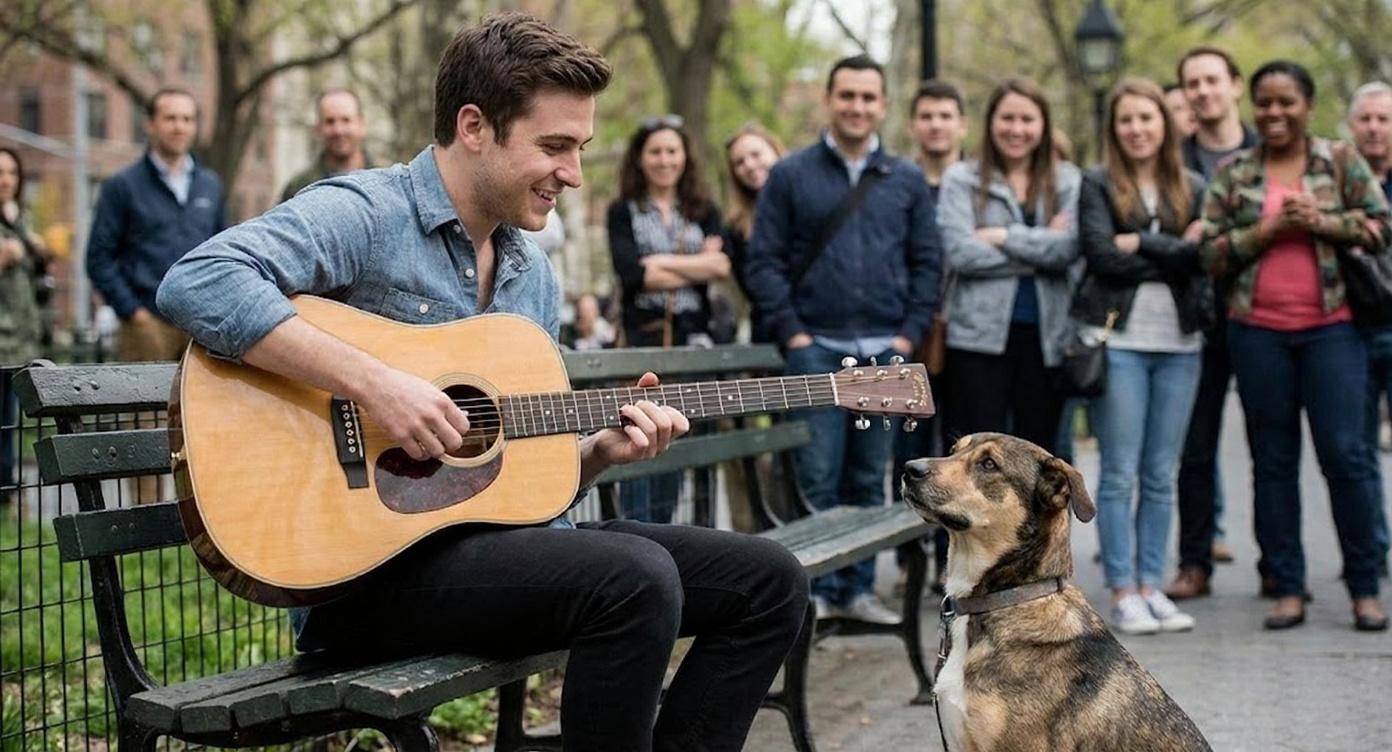
This one has more consistent support across the research. OkCupid's 2010 data found that activity and context photos — someone doing something — significantly outperformed static portraits. The effect wasn't marginal.
The reason is information density. An activity photo answers questions that a portrait can't: where does this person go, what do they do, what kind of life do they have. A headshot against a blank wall communicates one thing. A photo at a market, on a trail, at a table with friends communicates six things simultaneously — some of which are exactly what someone evaluating a potential match is trying to figure out.
The background answers part of the context signal even when the activity itself isn't foregrounded. A photo of you talking with someone at an event — even if 'what you're doing' isn't the point of the image — communicates social presence, environment, and context all at once.
↓ OkCupid OkTrends (2010). The 4 Big Myths of Profile Pictures.
What Are the 5 Signals a Strong Dating Profile Needs?
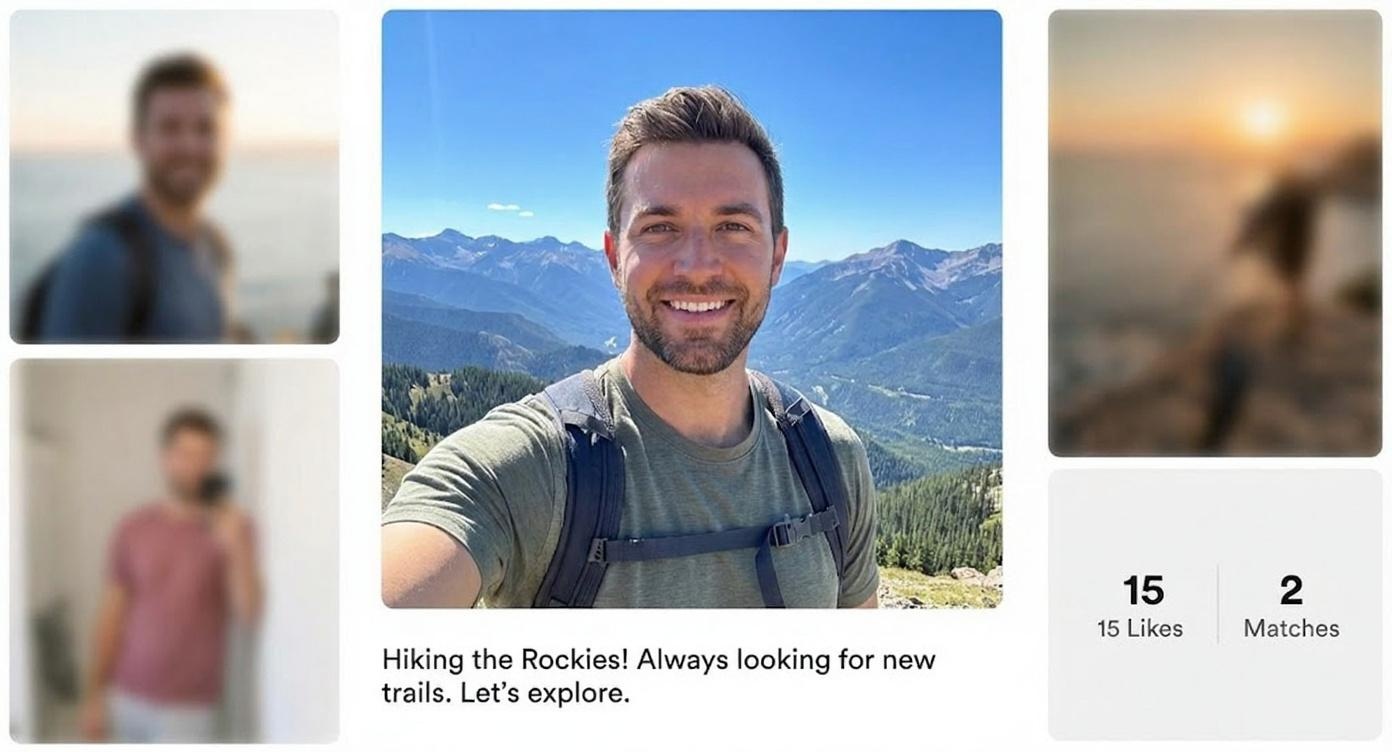
Direct answer: Every strong profile covers five distinct signals — not five photo types, but five questions a set of photos collectively answers. High-performing profiles don't have better individual photos. They have more complete signal sets. Each photo does a different job. Each one answers a different unspoken question.
| Signal | The Unspoken Question | What It Looks Like |
|---|---|---|
| Clarity | Is this actually who they say they are? Can I see them? | Face-forward shot. Clear light. Single subject. No sunglasses. |
| Full body / proportion | What does this person actually look like? | At least one photo from head to feet — candid, not posed. |
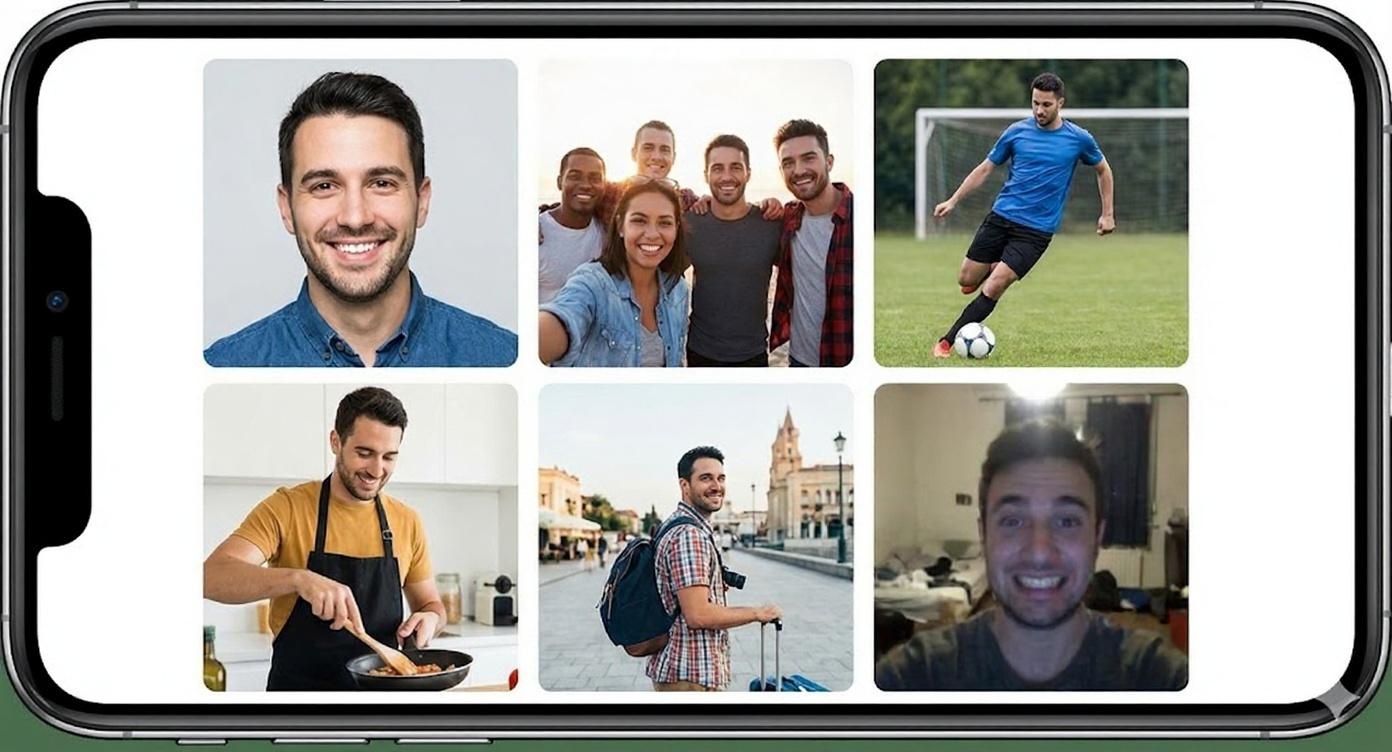
| Lifestyle context | What does this person's life look like? Do I fit in it? | You somewhere specific — traveling, outdoors, at an event, doing something. |
| Social proof | Is this someone other people want to be around? | A candid group shot where you're clearly part of the scene. |
| Conversation hook | Is there something here I can actually ask about? | A photo that raises a question: an unusual location, an activity, a specific detail. |
The key insight isn't the individual categories — it's what happens when any of them is missing. Profiles covering all five signals don't just perform better on one metric. They read as a complete picture. Profiles missing two or three signals leave gaps the brain tends to fill cautiously.
Most people approach their photos by choosing the ones where they look best — which optimizes for one signal (facial clarity, maybe proportion) while leaving the rest to chance. A profile that's missing lifestyle context, social proof, or any specific hook is competing on looks alone in a market where looks are the least differentiated variable.
This is why the question isn't just "do my photos look good?" It's "what is each photo actually proving?" Those are different questions with different answers.
PhotoLike.ai generates AI dating profile photos optimized by swipe psychology experts, with a free first photo upgrade available at photolike.ai. Expert-curated photo packages are built specifically around these signal dimensions, so each photo in the set is doing a defined job rather than just looking good. A complete signal set and a collection of flattering photos are not the same thing — and the data shows they don't perform the same way.
How Should You Build Your Dating Profile Photo Set?
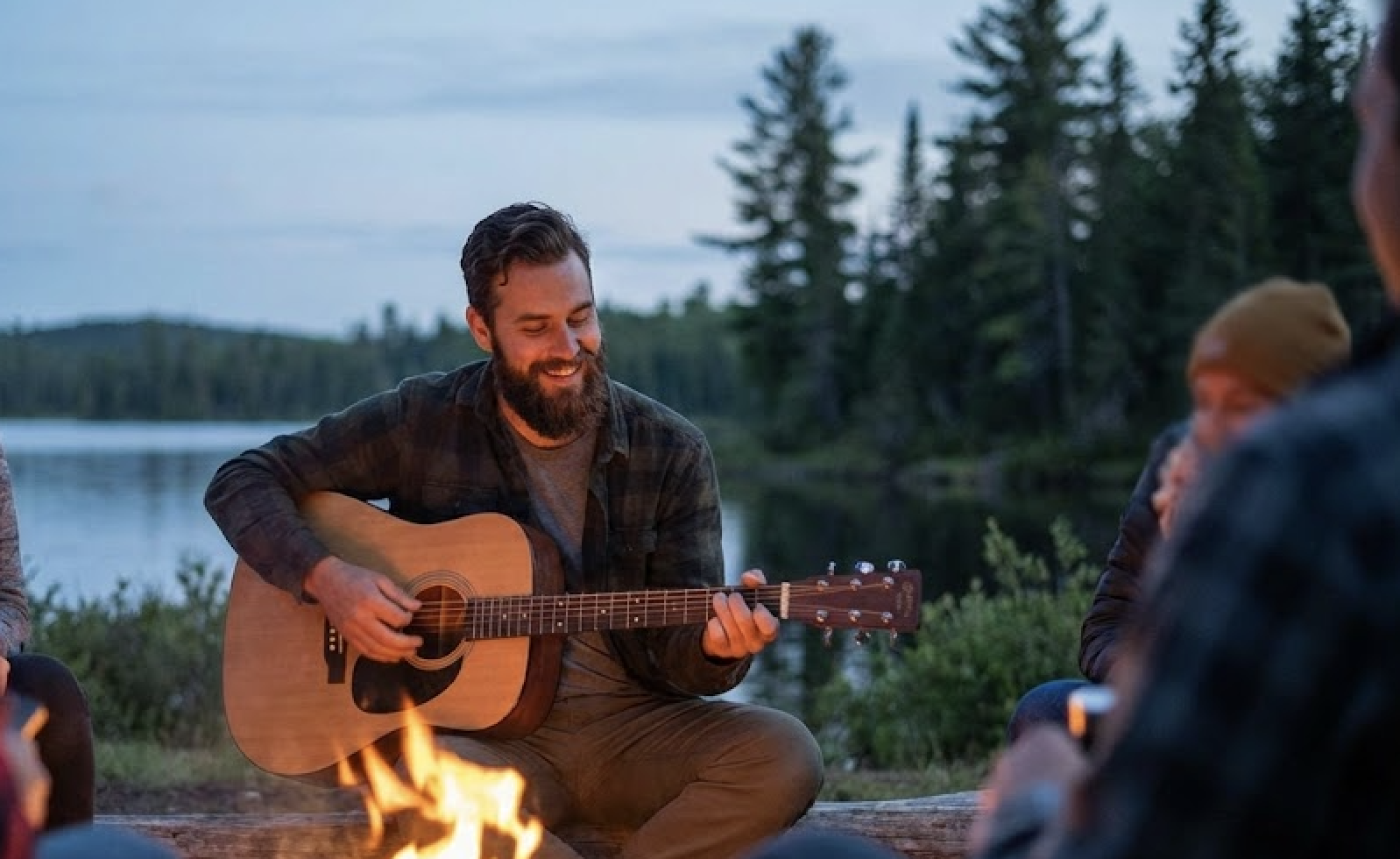
Direct answer: Build around the five signals above. Lead with your clearest photo, include at least one activity photo, show variety across contexts, and remove weak photos before adding new ones. The research on expression is genuinely split — don't let that detail distract from the signal framework.
Given that some advice in this space is contested and some isn't, here's a framework that sticks to findings with genuine support — structured around the five signals above, with the evidence base listed for each principle.
| Principle | What it Means | Evidence Base |
|---|---|---|
| Lead with your clearest photo | Your first slot should be unambiguous. One person, face visible, nothing visually competing for attention. | Todorov's fast-impression research: the lead image sets the tone before anything else is processed. |
| Show variety across your set | Different contexts, settings, and activities — not multiple versions of the same pose. | OkCupid (2010): context/activity photos outperformed generic portraits. Photofeeler: variety correlated with better ratings. |
| Include at least one activity or context photo | A photo where you're visibly somewhere or doing something, not just looking at the camera. | Consistent finding across OkCupid's data: doing something > standing there. |
| Don't overthink expression | Natural reads better than posed. Beyond that, the research is genuinely divided. | OkCupid (2010) vs. Photofeeler (2017): contradictory findings. Tracy & Beall (2011): lab conditions, not direct real-world application. |
| Remove weak photos rather than adding more | A set where every photo is solid outperforms a larger set with a few weak entries dragging it down. | Consistent with how impressions compound: a confusing photo creates a question mark that colors subsequent photos. |
| Don't rely on a single strong photo | One excellent photo can make someone pause, but a full set is what converts that pause into a match. | OkCupid data on variety; behavioral logic of multi-image profiles. |
Unlike generic AI headshot tools, PhotoLike.ai engineers each photo for the psychological signals that drive swipe decisions — which means the output isn't chosen for how it looks in a vacuum, but for the specific signal gap it fills in the full set.
Why Does Your Weakest Photo Set Your Profile's Ceiling?
Direct answer: People don't average their impressions of your photos — they anchor to the worst one. One confusing or weak photo pulls down the overall impression more than a strong photo pulls it up. Removing your worst photo often does more for your match rate than adding a new good one.
Behavioral research on multi-image evaluation consistently shows a negativity bias. When one image in a set is noticeably weaker or more confusing than the others, it pulls down the overall impression more than a strong image pulls it up. The outlier gets weighted.
A set of five strong photos beats a set of six photos where one is weak.
Removing your worst photo often does more for your effective profile than adding a new good one. 'Filler' shots — ones you included because you needed another image, not because they added something — are actively working against you.
This is also why the sequencing matters: before adding new photos, the first question is which existing ones are actively pulling the profile down. That's the logic behind how PhotoLike.ai structures its packages — photos created with specific signal targets in mind from the start, so every slot in the lineup is earning its place rather than filling a count.
The photos to audit most carefully:
- Sunglasses covering your eyes in the main slot — blocks the trust signals that form fastest

- Group shots where you're not immediately identifiable as the subject
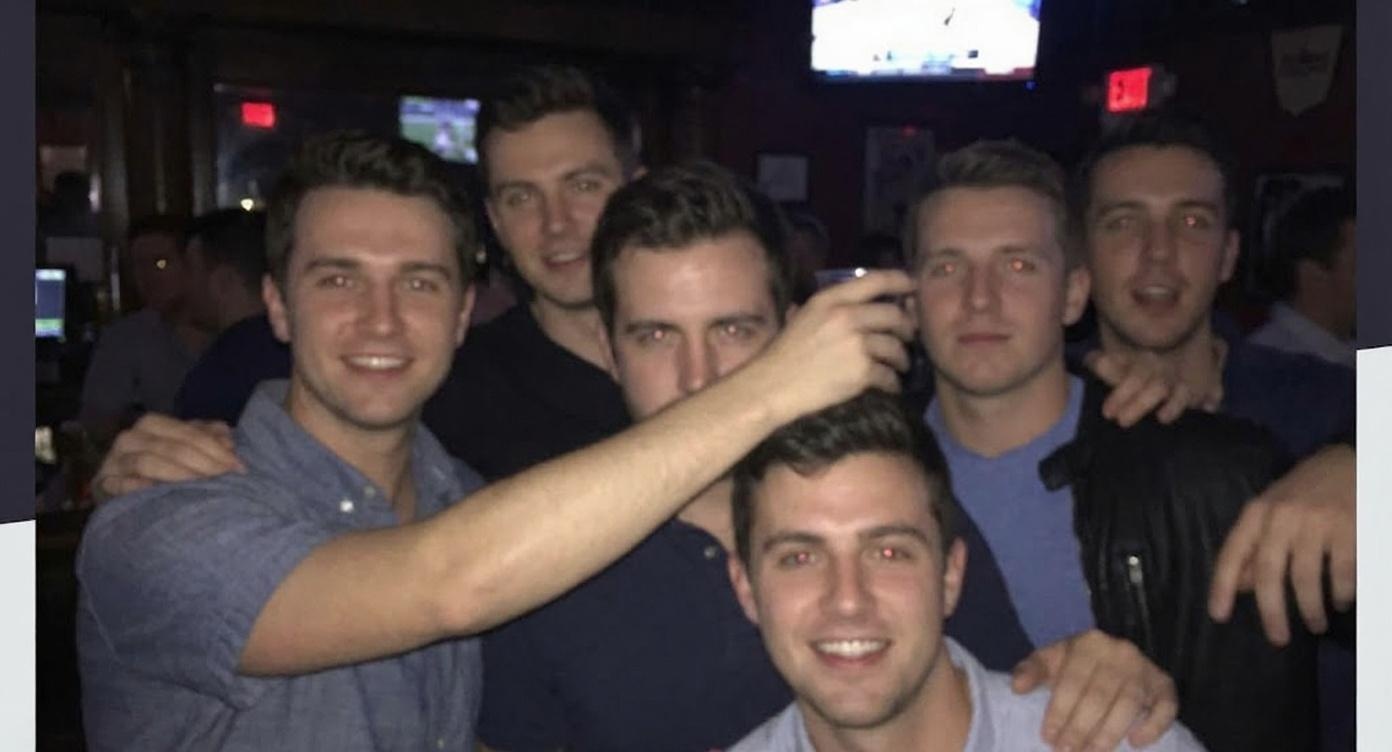
- Anything blurry, badly lit, or clearly phone-flash against a dark background

-
Photos that look like a visibly different version of you from the rest of the set — creates inconsistency that reads as confusing
-
Anything in the lineup primarily because you needed to hit a certain photo count
How Many Photos Should You Have on a Dating Profile?
Direct answer: Five is the consistent target across Tinder, Hinge, and Bumble. Enough to cover all five signals without redundancy. More than six starts introducing statistical risk — each additional photo increases the probability of including a weak one that anchors the overall impression downward.
| Count | What It Reads As | The Trade-off |
|---|---|---|
| 1–2 | Incomplete or overly private. | Not enough to build a picture. Underperforms regardless of individual photo quality. |
| 3–4 | Workable if photos are genuinely varied. | Limited room to cover signal categories. One weak photo has a bigger proportional impact. |
| 5–6 | The sweet spot. | Enough to cover all five signals without redundancy. Every photo earns its place. |
| 7+ | Starts introducing statistical risk. | At this volume, the probability of including a weak photo that drags down the overall impression increases significantly. |
The goal isn't to show as many photos as the platform allows. It's to show the five that cover the most signal ground with no weak links.
How Do You Audit Your Current Dating Profile Photos?
Direct answer: Run five checks — impression clarity at a glance, context variety across the set, lead photo legibility, friction points that create confusion, and whether any photo can be removed without losing a signal. The goal is to identify whether your current set covers the bases that have genuine evidence behind them.
Before investing in new photos, it's worth running a quick audit of what you already have.
-
Look at each photo for one second. What's the dominant impression? If it's unclear — or if the answer is 'this person looks fine' — the photo is probably not doing much work.
-
Count how many different contexts are showing. If three of your five photos are from the same apartment or the same angle, you're repeating a signal rather than adding new ones.
-
Check your first photo specifically. Is it immediately clear who you are? If someone else is in the photo, or if you're wearing sunglasses, that clarity is reduced. The lead photo does disproportionate work based on the Todorov research.
-
Look for any photo that raises a question rather than communicating something. A group photo where it's not immediately clear which person you are creates friction before anything else is assessed.
-
Ask whether any photo can be removed without losing something. If a photo is in your lineup because you needed to hit a certain count rather than because it adds something new, it's worth reconsidering.
The honest difficulty with this audit: you can't see your own photos the way a stranger does in the first second. You know which photo was from a good trip, which one represents who you actually are, which one you worked hard for. None of that context travels.
The viewer has one cold look and a fraction of a second. That gap — between how you see your photos and how they're actually being read — is the real problem most profiles are failing to solve.
PhotoLike.ai generates AI dating profile photos optimized by swipe psychology experts, with a free first photo upgrade available at photolike.ai. The free upgrade lets you see the before/after on your own face — what a cold viewer actually sees versus what you assume they see — before committing to anything further.
See The Difference
Your photos do the talking before you do. Make sure they're saying the right thing.
Unflattering angle • Harsh lighting • Missed potential

Confident pose • Perfect lighting • Match-ready
1 free match-ready photo first • unlock 40 for $24.99 only if you love it • no card required
Get Your First AI Photo Free
See the quality before you spend a cent
Love it? Unlock 40 for $24.99
Not for you? Walk away—no card required, no charge
Related Guides
- Dating Profile Photos: What the Research Says About What Works
- What Women Actually Respond to in Dating Photos
- Why Men Get So Few Matches on Dating Apps
- 8 Dating Photo Mistakes That Kill Your Match Rate
- AI Dating Photos: What's Allowed, What's Not, and What Actually Works
Sources
All research cited in this guide links to the original study or primary source. Where findings conflict, both sides are shown.
-
Willis, J., & Todorov, A. (2006). First impressions: Making up your mind after a 100-ms exposure to a face. Psychological Science, 17(7), 592–598. https://doi.org/10.1111/j.1467-9280.2006.01750.x
-
Tracy, J. L., & Beall, A. T. (2011). Happy guys finish last: The impact of emotion expressions on sexual attraction. Emotion, 11(6), 1379–1387. https://doi.org/10.1037/a0022902
-
OkCupid OkTrends. (2010, January 20). The 4 big myths of profile pictures. Archived: http://gwern.net/doc/psychology/okcupid/the4bigmythsofprofilepictures.html
-
Photofeeler. (2017). OkCupid is wrong about men's dating photos, and we replicated their study to prove it. http://blog.photofeeler.com/okcupid-is-wrong-about-smiling-eye-contact-mens-dating-profile-photos/
On This Page
Frequently Asked Questions
A good dating profile photo communicates one of five signals clearly: who you actually look like (clarity), what you look like head to toe (proportion), that you have a life and exist somewhere interesting (lifestyle context), that you're someone other people want to be around (social proof), or that there's something specific to ask about (conversation hook). The best profiles use multiple photos to cover all five — not one 'hero' shot trying to do everything at once.
The research doesn't fully agree on this — and it's worth knowing why. The University of British Columbia's 2011 study found confident, non-smiling expressions were rated more sexually attractive than big happy smiles for men. OkCupid's 2010 platform data confirmed this directionally. A 2017 Photofeeler replication found no statistically significant difference between smiling and not smiling. The most consistent finding across all three: natural and relaxed outperforms visibly posed or performative. Beyond that, the evidence is genuinely split — anyone stating a clear universal answer on this is overstating what the data shows.
Five is the consistent target. It covers all five signal categories without padding. Fewer than four reads as incomplete and gives the set limited range. Seven or more introduces statistical risk — at that volume, the probability of including a weak photo that drags the overall impression down increases significantly.
Yes — significantly. The first photo slot determines whether someone taps to see more. A group shot, a sunglasses photo, or a low-clarity image in the first slot means many people never see your better photos at all. Research on rapid face perception shows the initial impression forms before conscious evaluation happens — the lead photo shapes how everything after it gets read.
Based on available platform data: photos with interesting contextual backgrounds (outdoors, travel, real environments) outperform equivalent shots against blank backgrounds. Clear headshots where your face is visible and prominent outperform cropped or distant shots in the first slot. Photos that communicate a specific lifestyle signal — doing something, being somewhere — consistently outperform generic posed portraits.
Not necessarily. OkCupid's 2010 analysis found self-shot phone and webcam photos performed about as well as professionally taken ones — which surprised a lot of people at the time. What correlates with better performance is lighting quality, clarity, and whether a photo looks natural rather than staged. A sharp, well-lit phone photo often outperforms a professional studio shot that looks visibly posed.
Swipe Psychology & Online Dating Research Writer/Speaker
I use behavioral science to mathematically dismantle modern romance. When I'm done optimizing human attraction, I drink black coffee and play chess.